

Project C05:
Large-scale structure and variability of lowermost stratospheric water vapour
Brief Summary
Water vapor in the lowermost stratosphere (LMS) has been identified to act as an important positive climate feedback with significant associated circulation feedbacks. However, current global climate models simulate large moist biases in the LMS which, in turn, cause significant biases in the simulated circulation: an upward shift of subtropical jets, poleward shifts of the tropospheric eddy-driven jet and an intensified stratospheric circulation (Charlesworth et al., 2023). The distribution of water vapor in the LMS is in part controlled by transport, and in part by temperature and microphysics, which introduce large uncertainties to many aspects regarding the climate relevance of the UTLS. The strong horizontal and vertical gradients of water vapor near the tropopause enhance sensitivities and thereby further complicate quantitative estimates of the associated climate effects.
In this project we will leverage the tracer budget framework in isentropic coordinates that we successfully implemented for ozone during phase 1. This budget approach allows insights into contributions from different transport processes: 1) residual/diabatic circulation transport, 2) adiabatic and diabatic eddy mixing (including contributions by different scales). We will work with both ERA5 and climate model output and carefully consider sources and sinks, especially due to microphysics near the tropopause. We will also work toward a statistical bias correction for reanalyses and climate models of water vapor in the LMS.
We will focus on the variability of LMS water vapor on different time scales by using combined high quality aircraft observations of the last 20 years including long-term observations from IAGOS and high numerous research aircraft campaigns. The data are consistently referenced to ERA 5 data along the flight track. We will determine mean LMS distributions and the variability of water vapor on different timescales from synoptic scale to multiannual time scale. We will further analyze its relation to the tropopause and Lagrangian cold point to infer potential transport pathways determining the role of the Lagrangian cold point for the water vapor in the LMS. We will derive the properties and variability of on different time scales. Using the DLM as well as classical regression models we will derive potential trends.
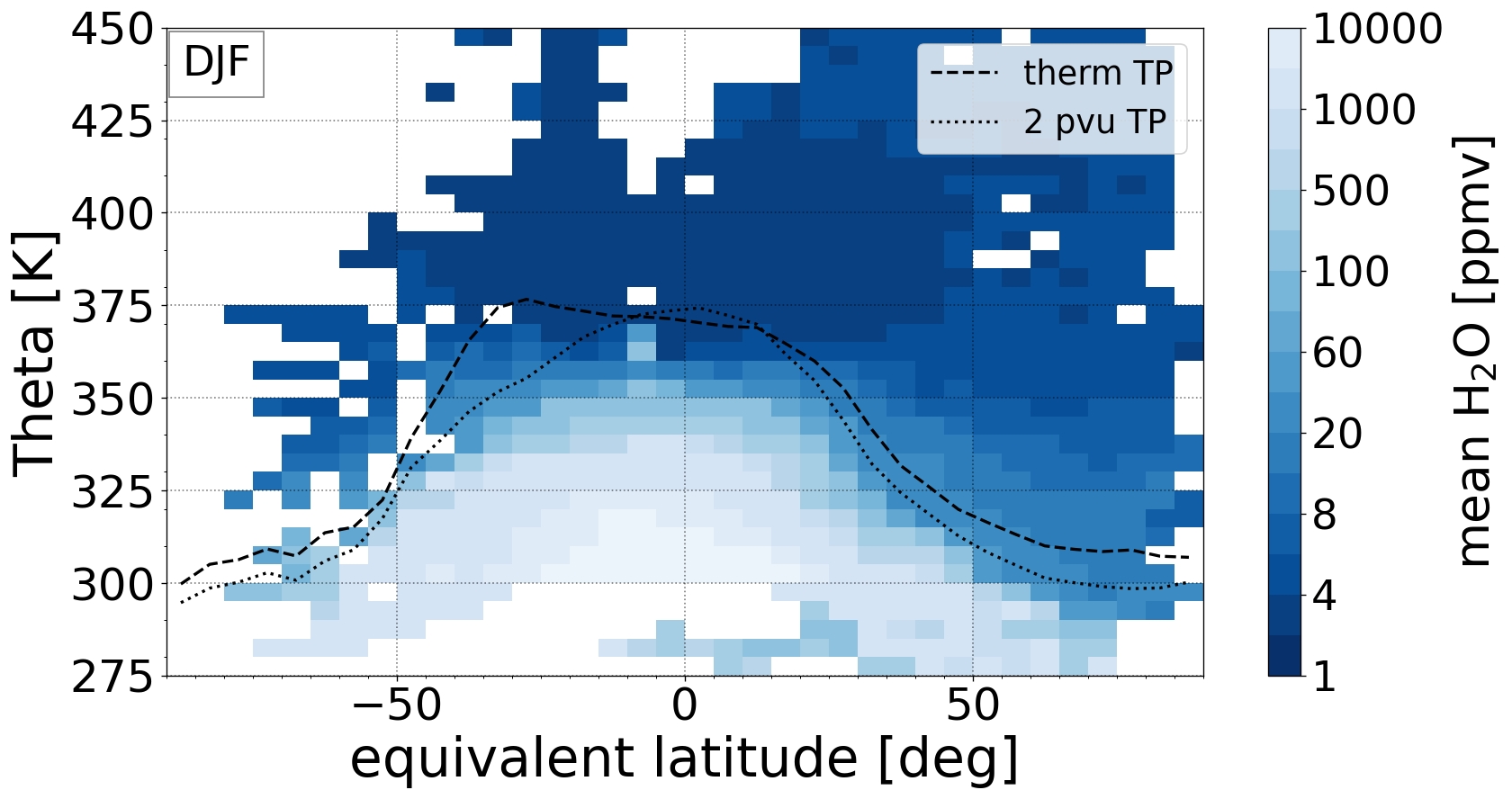
Quasi-zonal mean distribution of H2O from observations for northern winter time with potential temperature (Theta) as vertical axis. Dashed and dotted lines show different definitions of the tropopause.
Project Poster
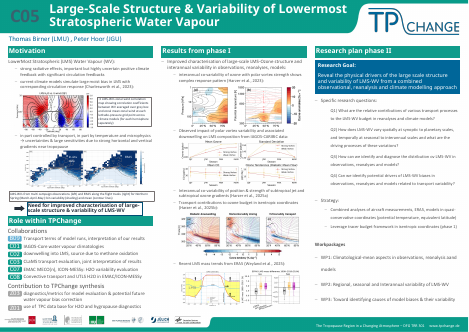
Evaluation Poster Phase I in 2025
Members

Prof. Dr. Thomas Birner
Principal Investigator
Ludwig-Maximilians-Universität München, Meteorologisches Institut
thomas.birner[at]physik.uni-muenchen.de

Prof. Dr. Peter Hoor
Principal Investigator
Johannes Gutenberg-Universität Mainz, Institut für Physik der Atmosphäre
hoor[at]uni-mainz.de

Laura Braschoß
Doctoral candidate
Ludwig-Maximilians-Universität München, Meteorologisches Institut
l.braschoss[at]lmu.de

Naikang Zhang
Doctoral candidate
Johannes Gutenberg-Universität Mainz, Institut für Physik der Atmosphäre
nazhang[at]uni-mainz.de

Former Member Phase I:
Frederik Harzer
Doctoral candidate
Ludwig-Maximilians-Universität München, Meteorologisches Institut

Former Member Phase I:
Vaidehi Joshi
Doctoral candidate
Johannes Gutenber-Universität Mainz, Institut für Physik der Atmosphäre
Publications
Smoydzin, L., V. Bense, H. Bozem, P. Joppe, D. Kunkel, H.-C. Lachnitt, H. Tost, A. Zahn, H. Ziereis, M. Riese, and P. Hoor (2026): Impact of South American biomass burning emissions on elevated South Atlantic upper tropospheric ozone. Atmospheric Chemistry and Physics 26 (16), 11857–11874. doi: 10.5194/acp-26-11857-2026.
Harzer, F., H. Garny, F. Ploeger, J. M. Menken, and T. Birner (2025b): Adiabatic versus diabatic transport contributions to the ozone budget in the northern hemispheric upper troposphere and lower stratosphere. Atmospheric Chemistry and Physics 25 (21), 14909–14921. doi: 10.5194/acp-25-14909-2025.
Harzer, F., H. Garny, S. M. Davis, and T. Birner (2025a): Probing the suitability of meridional stratospheric ozone gradients for inferring interannual variability and trends of the subtropical jet stream. J. Climate 38, 2571–2588. doi: 10.1175/JCLI-D-24-0530.1.
Weyland, F., P. Hoor, D. Kunkel, T. Birner, F. Plöger, and K. Turhal (2025): Long-term changes in the thermodynamic structure of the lowermost stratosphere inferred from reanalysis data. Atmospheric Chemistry and Physics 25 (2), 1227–1252. doi: 10.5194/acp-25-1227-2025.
Ploeger, F., T. Birner, E. Charlesworth, P. Konopka, and R. Müller (2024): Moist bias in the Pacific upper troposphere and lower stratosphere (UTLS) in climate models affects regional circulation patterns. Atmospheric Chemistry and Physics 24 (3), 2033–2043. doi: https://doi.org/10.5194/acp-24-2033-2024.
Charlesworth, E., F. Ploeger, T. Birner, R. Baikhadzhaev, M. Abalos, L. Abraham, H. Akiyoshi, S. Bekki, F. Dennison, P. Jöckel, J. Keeble, D. Kinnison, O. Morgenstern, D. Plummer, E. Rozanov, S. Strode, G. Zeng, and M. Riese (2023): Stratospheric water vapor affecting atmospheric circulation. 14, doi: https://doi.org/10.1038/s41467-023-39559-2.
Harzer, F., H. Garny, F. Ploeger, H. Bönisch, P. Hoor, and T. Birner (2023): On the pattern of interannual polar vortex-ozone co-variability during northern hemispheric winter. Atmospheric Chemistry and Physics 23 (18), 10661–10675. doi: 10.5194/acp-23-10661-2023.
Boljka, L. and T. Birner (2022): Potential impact of tropopause sharpness on the structure and strength of the general circulation. npj Climate and Atmospheric Science 5, (1), 2397–3722. doi: https://doi.org/10.1038/s41612-022-00319-6.
Ziereis, H., P. Hoor, J.-U. Grooß, A. Zahn, G. Stratmann, P. Stock, M. Lichtenstern, J. Krause, V. Bense, A. Afchine, C. Rolf, W. Woiwode, M. Braun, J. Ungermann, A. Marsing, C. Voigt, A. Engel, B.-M. Sinnhuber, and H. Oelhaf (2022): Redistribution of total reactive nitrogen in the lowermost Arctic stratosphere during the coldwinter 2015/2016. Atmospheric Chemistry and Physics 22 (5), 3631–3654. doi: https://doi.org/10.5194/acp-22-3631-2022.