

Project C07:
Controlling Factors of Oxidants and Aerosols in the Upper Troposphere and Lower Stratosphere and the Anthropogenic Influence (COATS)
Brief Summary
The large-scale chemical composition of the upper troposphere and lower stratosphere (UTLS) is influenced by a wide range of physical and chemical processes. To understand the key factors controlling gas- and aerosol-phase composition in this region, the use of a numerical model is essential. In this project, we will perform and analyze numerical simulations with the ICON/MESSy model to investigate the budgets of oxidants and aerosols in the UT and LS.
A particular focus will be placed on the OH budget in the upper troposphere, with special attention to the relative importance of primary and secondary oxidant production mechanisms. We will explore the influence of lightning and convective transport of boundary layer air masses on ozone and OH formation by, for example, assessing the sensitivity of simulated ozone and OH production to different lightning parameterizations.
In addition to trace gases, the model system will be applied to study the aerosol budget in the UTLS region. Both transport fluxes and chemical budgets will be analyzed to improve our understanding of aerosol lifetimes at these altitudes, their radiative impacts, and the resulting feedbacks on UTLS dynamics, with the goal of simulating aerosols concentrations in a coherent and consistent way for the entire atmosphere (see Figure).
The overarching goal of the project is to identify the key precursors responsible for in situ ozone formation, as well as the formation and growth of aerosols through nucleation and coagulation processes. Model predictions of gas and aerosol composition will be evaluated using observational data from HALO campaigns—particularly PHILEAS and CONTANGO-FIRE—as well as results from the previous project phase.
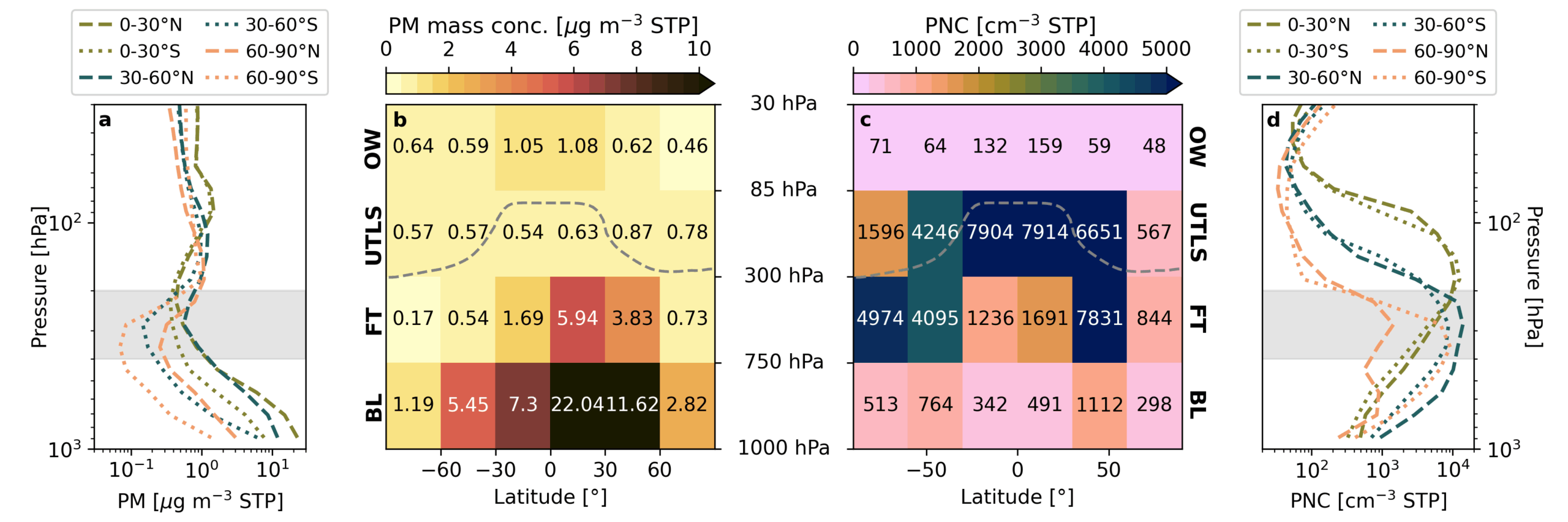
Zonally and annually (2017) averaged global aerosol mass (b) and particle number concentrations (PNC; c) in the boundary layer (BL), the free troposphere (FT), the upper troposphere / lower stratosphere (UTLS), and the stratospheric overworld (OW), along with the corresponding averaged profiles (a,d) simulated by the EMAC model. The grey shaded area between 400 and 200 hPa marks the transition region between the FT and the UTLS, where lowest mass concentrations are simulated.
Project Poster
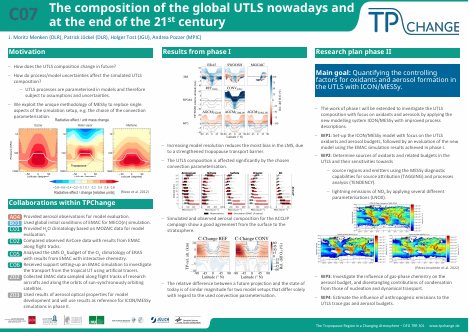
Evaluation Poster Phase I in 2025
Members

Dr. Patrick Jöckel
Principal Investigator
Deutsches Zentrum für Luft- und Raumfahrt, Institut für Physik der Atmosphäre
patrick.joeckel[at]dlr.de

Prof. Dr. Andrea Pozzer
Principal Investigator
Abteilung Atmosphärenchemie, Max-Planck-Institut für Chemie
andrea.pozzer[at]mpic.de

Prof. Dr. Holger Tost
Principal Investigator
Johannes Gutenberg-Universität Mainz, Institut für Physik der Atmosphäre
tosth[at]uni-mainz.de

Dr. Matthias Kohl
Postdoc
Abteilung Atmosphärenchemie, Max-Planck-Institut für Chemie
m.kohl[at]mpic.de

Dominik Kampe
Doctoral Candidate
Deutsches Zentrum für Luft- und Raumfahrt, Institut für Physik der Atmosphäre
dominik.kampe[at]dlr.de

Former Member Phase I:
Moritz Menken
Doctoral Candidate
Deutsches Zentrum für Luft- und Raumfahrt, Institut für Physik der Atmosphäre
Publications
Hernández Pardo, L., J. Curtius, P. Jöckel, J. M. Menken, C. Pöhlker, M. Pöhlker, and A. Possner (2026): Down- ward transport of tropical upper-tropospheric aerosols: multi-year insights from idealized simulations. Atmospheric Chemistry and Physics 26 (17), 12275–12293. doi: 10.5194/acp-26-12275-2026.
Kohl, M., C. Brühl, H. Tost, C. Xenofontos, T. Christoudias, S. Gromov, O. Appel, S. Borrmann, A. Bourassa, P. Campunzano-Jost, Y. Cheng, O. Eppers, K. D. Froyd, B. A. Holanda, J. L. Jimenez, P. Jöckel, P. Joppe, K. Kaiser, J. M. Katich, K. Klingmüller, F. Köllner, A. Kupc, A. Martin, C. Pöhlker, M. L. Pöhlker, U. Pöschl, L. Rieger, S. Ruhl, G. P. Schill, J. Schneider, C. Schulz, J. P. Schwarz, A. P. Tsimpidi, R. Vella, C. J. Williamson, Y. Yang, D. Zawada, J. Lelieveld, and A. Pozzer (2026): Global atmospheric aerosol distributions and composition from the Earth’s surface to the stratosphere. EGUsphere 2026, [Preprint], 1–54. doi: 10.5194/egusphere-2026-3649.
Degen, J., B. C. Baier, P. Jöckel, J. M. Menken, T. J. Schuck, C. Sweeney, and A. Engel (2025): CO2 variability and seasonal cycle in the UTLS: insights from EMAC model and AirCore observational data. Atmospheric Chemistry and Physics 25 (22), 15741–15763. doi: 10.5194/acp-25-15741-2025
Harzer, F., H. Garny, F. Ploeger, J. M. Menken, and T. Birner (2025b): Adiabatic versus diabatic transport contributions to the ozone budget in the northern hemispheric upper troposphere and lower stratosphere. Atmospheric Chemistry and Physics 25 (21), 14909–14921. doi: 10.5194/acp-25-14909-2025.
Kohl, M., C. Brühl, J. Schallock, H. Tost, P. Jöckel, A. Jost, S. Beirle, M. Höpfner, and A. Pozzer (2025): New submodel for emissions from Explosive Volcanic ERuptions (EVER v1.1) within the Modular Earth Submodel System (MESSy, version 2.55.1). Geoscientific Model Development 18 (13), 3985–4007. doi: 10.5194/gmd-18-3985-2025.