
Project B03:
Moist convection and tracer transport into and
out of the Asian Summer Monsoon Anticyclone
Brief Summary
This project aims to understand how the Asian Summer Monsoon Anticyclone (ASMA) and the complex terrain of the Third Pole region (the Himalayas and the Tibetan Plateau) influence the exchange of water vapour and other trace gases between the atmospheric boundary layer (ABL) and the Upper Troposphere Lower Stratosphere (UTLS). The study investigates the dominant transport mechanisms governing water vapour exchange into and within the ASMA and quantifies moisture transport from the ASMA into the extratropics. To achieve this, it focuses mainly on identifying hotspot regions of rapid and slow vertical transport and exploring the relative roles of deep convection, orographic lifting, cloud-jumping, and wave-breaking processes in carrying water vapour to the UTLS. Understanding these mechanisms will improve the representation of the ASMA in regional and global climate models, which currently exhibit systematic wet biases during the monsoon season, thereby improving the simulation of radiative and dynamical processes influenced by the ASMA.
The project uses the ICON modelling framework in regional, convection-resolving, and LES configurations, integrating tracer and trajectory analyses, with a key focus on improving the model’s representation of turbulence and convection. We aim to examine how parameterized turbulence affects the transport and mixing of atmospheric constituents during deep convection by comparing the TKE- based turbulence scheme with a two-energies (2TE) scheme that unifies turbulence and shallow convection. The work will also assess which components of the turbulence scheme most improve simulations of convective transport in the UTLS, such as refining turbulence length scales, including the effects of horizontal wind shear, and representing horizontal mixing more realistically. Together, these efforts will lead to a better understanding of ASMA’s role in shaping the upper atmosphere and contribute to more accurate climate predictions for the South Asian region. The schematic figure below summaries the four main objectives of the project:
- To understand the transport of water vapour into and within ASMA.
- To identify hotspot regions from where air parcels moisten the ASMA through different processes.
- To investigate water vapour exchange from ASMA to extratropical tropopause.
- To examine the influence of synoptic processes on ASMA moistening.
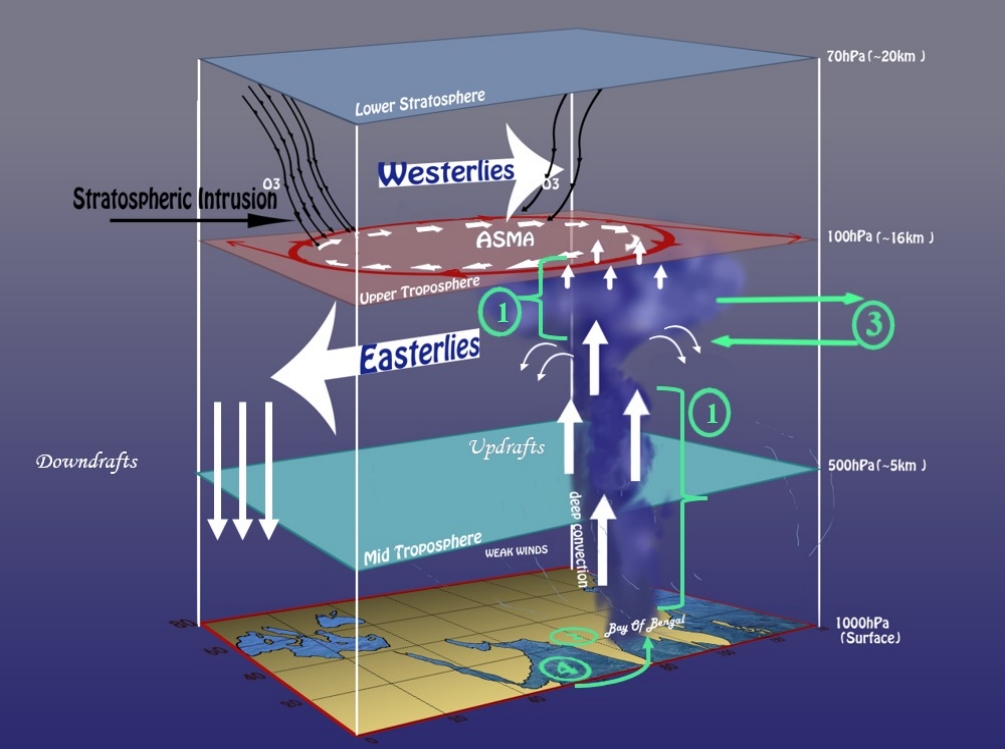
Schematic representation of the investigation process related to ASMA, figure adapted from Alladi et al., 2022.
Project Poster
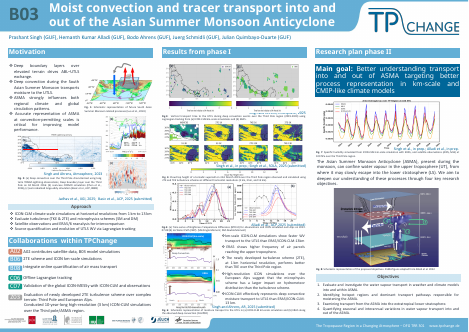
Evaluation Poster Phase I in 2025
Members

Prof. Dr. Bodo Ahrens
Principal Investigator
Goethe-Universität Frankfurt, Institut für Atmosphäre und Umwelt
bodo.ahrens[at]iau.uni-frankfurt.de

Prof. Dr. Jürg Schmidli
Principal Investigator
Goethe-Universität Frankfurt, Institut für Atmosphäre und Umwelt
schmidli[at]iau.uni-frankfurt.de

Dr. Prashant Singh
Postdoc
Goethe-Universität Frankfurt, Institut für Atmosphäre und Umwelt
p.singh[at]iau.uni-frankfurt.de

Dr. Hemanth Kumar Alladi
Postdoc
Goethe-Universität Frankfurt, Institut für Atmosphäre und Umwelt
alladi[at]iau.uni-frankfurt.de

Former member:
Dr. Praveen K. Pothapakula
Postdoc
Goethe-Universität Frankfurt, Institut für Atmosphäre und Umwelt
Publications
Alladi, H. K., J. Quimbayo-Duarte, L. Bugliaro, J. Mayer, S. Singh, and J. Schmidli (2026): Evaluating turbulent and microphysical schemes in ICON for deep convection over the Alps: a case study of vertical transport and model–observation comparison. Atmospheric Chemistry and Physics 26 (12), 8617–8635. doi: 10.5194/acp-26-8617-2026.
Balasundhar, B., H. K. Alladi, M. V. Ratnam, and A. Kottayil (2026a): Comprehensive evaluation of Aeolus wind measurements against in situ observations and reanalysis datasets over the Indian monsoon region. European Journal of Remote Sensing 59 (1), 2712601. doi: 10.1080/22797254.2026.2712601.
Balasundhar, B., H. K. Alladi, M. Venkat Ratnam, M. Ratynski, and P. Singh (2026b): Evaluating Aeolus HLOS Winds and Characterizing the Low-Level Jet (LLJ) and Tropical Easterly Jet (TEJ) over the Indian Summer Monsoon: An Intercomparison with Radiosonde and Reanalysis Datasets. Remote Sensing 18 (18), doi: 10.3390/rs18183077.
Basic, I., H. Jadhav, J. Singh, and J. Schmidli (2026): Impact of small-scale orography on deep boundary layer evolution and structure over the Tibetan Plateau. Atmospheric Chemistry and Physics 26 (3), 2007–2025. doi: 10.5194/acp-26-2007-2026.
Bharath, J., T. V. Lakhsmi Kumar, K. K. Rao, H. K. Alladi, H. Barbosa, and R. K. Mall (2026): Formation and photolysis of multifunctional organic nitrates from the reaction of limonene and NO3 radicals. Climate Dynamics 64 (226), doi: 10.1007/s00382-026-08154-8.
Tian, Y., J. Quimbayo Duarte, S. Singh, and J. Schmidli (2026): Comparison of two numerical weather prediction models in simulating south foehn in the Alpine Rhine Valley. Quarterly Journal of the Royal Meteorological Society 152 (777), e70122. doi: https://doi.org/10.1002/qj.70122.
Jadhav, H., P. Singh, B. Ahrens, and J. Schmidli (2025): Machine Learning-Based Identification of Key Predictors for Lightning Events in the Third Pole Region. ISPRS International Journal of Geo-Information 14 (8), doi: 10.3390/ijgi14080319.
Rameshan, A., P. Singh, and B. Ahrens (2025): Cross-Examination of Reanalysis Datasets on Elevation-Dependent Climate Change in the Third Pole Region. Atmosphere 16 (3), doi: 10.3390/atmos16030327.
Quimbayo-Duarte, J., J. Schmidli, M. Köhler, and L. Schlemmer (2025): Analysis of the wind response to resolved versus parametrized turbulent orographic drag in high-resolution simulations. Quarterly Journal of the Royal Meteorological Society, e4977. doi: 10.1002/qj.4977.
Rameshan, A., P. Singh, and B. Ahrens (2025): Cross-Examination of Reanalysis Datasets on Elevation-Dependent Climate Change in the Third Pole Region. Atmosphere 16 (3), doi: 10.3390/atmos16030327
Singh, P. and B. Ahrens (2025): Lightning-intense deep convective transport of water vapour into the UTLS over the Third Pole region. Atmospheric Chemistry and Physics 25 (23), 17869–17888. doi: 10.5194/acp-25-17869-2025.
Alladi, H. K., P. Satheesh Chandran, and V. R. M (2024): Impact of ENSO on the UTLS chemical composition in the Asian Summer Monsoon Anticyclone. Atmospheric Research 309, 107551. doi: https://doi.org/10.1016/j.atmosres.2024.107551.
Collier, E., N. Ban, N. Richter, B. Ahrens, D. Chen, X. Chen, H.-W. Lai, R. Leung, L. Li, A. Medvedova, T. Ou, P. K. Pothapakula, E. Potter, A. F. Prein, K. Sakaguchi, M. Schroeder, P. Singh, S. Sobolowski, S. Sugimoto, J. Tang, H. Yu and C. Ziska (2024): The first ensemble of kilometer-scale simulations of a hydrological year over the third pole. Climate Dynamics, 1432 – 0894. doi: 10.1007/s00382-024-07291-2.
Williams, M. A., H. K. Alladi, V. Jayachandran, M. K. Thakur, and T. V. L. Kumar (2024): Effect of Wet Scavenging on Black Carbon Aerosols over a Coastal Urban Site in India. Air Quality, Atmosphere & Health, 1873–9326. doi: https://doi.org/10.1007/s11869-024-01626-y.
Prein, A. F., N. Ban, T. Ou, J. Tang, K. Sakaguchi, E. Collier, S. Jayanarayanan, L. Li, S. Sobolowski, X. Chen, X. Zhou, H.-W. Lai, S. Sugimoto, L. Zou, S. u. Hasson, M. Ekstrom, P. K. Pothapakula, B. Ahrens, R. Stuart, H. C. Steen-Larsen, R. Leung, D. Belusic, J. Kukulies, J. Curio, and D. Chen (2023): Towards Ensemble-Based Kilometer-Scale Climate Simulations over the Third Pole Region. Climate Dynamics 60, (11), 4055–4081. doi: https://doi.org/10.21203/rs.3.rs-1570621/v1.
Schmidli, J. and J. Quimbayo-Duarte (2023): Diurnal Valley Winds in a Deep Alpine Valley: Model Results. Meteorology 2 (1), 87–106. doi: https://doi.org/10.3390/meteorology2010007.
Singh, P. and B. Ahrens (2023): Modeling Lightning Activity in the Third Pole Region: Performance of a km-Scale ICON-CLM Simulation. Atmosphere 14 (11), doi: 10.3390/atmos14111655.
Quimbayo-Duarte, J., J. Wagner, N. Wildmann, T. Gerz, and J. Schmidli (2022): Evaluation of a forest parameterization to improve boundary layer flow simulations over complex terrain. A case study using WRF-LES V4.0.1. Geoscientific Model Development 15 (13), 5195–5209. doi: 10.5194/gmd-15-5195-2022.