
News

1) Comprehensive evaluation of Aeolus wind measurements against in situ observations and reanalysis datasets over the Indian monsoon region Balasundhar, B., H. K....

Downward transport of tropical upper-tropospheric aerosols: multi-year insights from idealized simulations.Hernández Pardo, L., J. Curtius, P. Jöckel, J. M. Menken, C....

A new TPChange activity was launched this summer: taking part in a run together! The "Goethe run" took place on the 26th August 2026 and was organised by the collegiate...
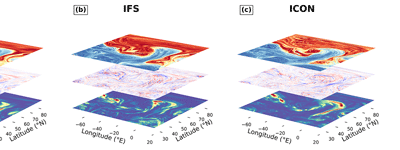
Evidence of gravity wave contribution to vertical shear and mixing in the lower stratosphere. Umbarkar, M., D. Kunkel, A. Miltenberger, H.-C. Lachnitt, T. Kaluza, C....
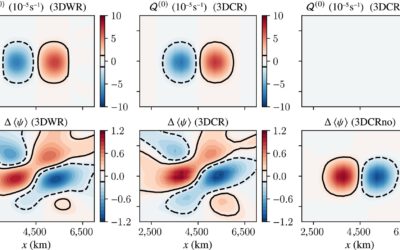
Impact of small-scale gravity waves on tracer transportKnop, I., S. Dolaptchiev, and U. Achatz (2026): Quarterly Journal of the Royal Meteorological Society 152 (776),...
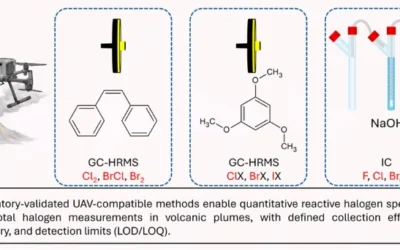
On-filter derivatisation and alkaline trap sampling for UAV-based gas-phase halogen speciation in volcanic plumes Geil, B., N. Bobrowski, and T....

Planned for 2026/2027: Workshop on Voice and Body Language for female ECR 3rd Workshop for female PI Workshop on communication in diverse teams and more
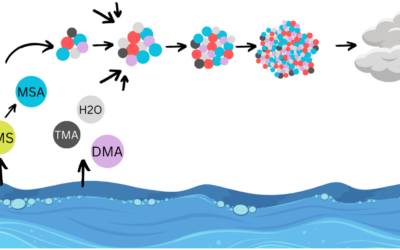
CERN CLOUD chamber measurements investigate the synergistic new particle formation rates and mechanisms involving methanesulfonic acid, sulfuric acid and two different...
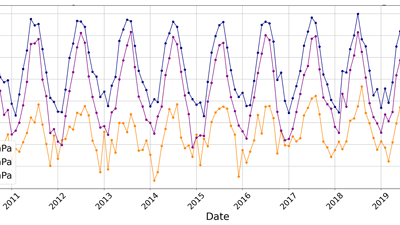
We studied ice-supersaturated regions in the upper troposphere and lower stratosphere where high humidity can lead to cloud and contrail formation. Using data from 2010...
The Tropopause Region in a Changing Atmosphere
Transregional Collaborative Research Centre TRR 301
Projections of climate change rely on an adequate representation of UTLS processes and their feedbacks in climate models. In the Collaborative Research Centre TPChange this is addressed by a combination of field measurements, laboratory studies, theoretical approaches, and multiscale numerical modelling. Based on an improved understanding of relevant processes at different scales, we will develop parameterisations to improve state-of-the-art climate models. Our goal is to specify the impact of UTLS processes on composition, dynamics and ultimately on future climate and climate variability.
The scientific projects in TPChange are organised in three main research areas:

Research Area A: Aerosols, clouds and chemistry
This Research Area focuses on the role of aerosol and ice particles in the UTLS, their formation, chemistry, evolution and effect on the atmospheric radiation budget.

Research Area B: Small scale dynamics and microphysics
This Research Area investigates the interaction of dynamical and microphysical processes in the UTLS.

Research Area C: Large scale distributions, processes and impact
This Research Area focuses on large scale processes and the impact of processes of all scales on UTLS composition and variability, their expected changes in the future and their impact on present and future climate.
Overview
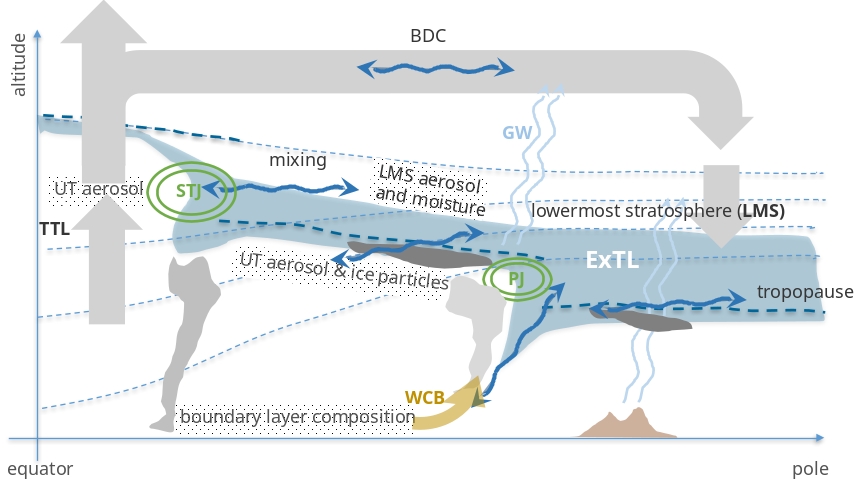
Schematic of the upper troposphere and lower stratosphere with key components and processes.
BDC: Brewer-Dobson circulation, ExTL: extra-tropical tropopause transition layer, GW: gravity wave,
PJ: polar jet, STJ: sub-tropical jet, TTL: tropical tropopause layer, WCB: warm conveyor belt
Climate change is without doubt one of the largest and most pressing problems of mankind for the upcoming decades. Robust and reliable climate projections are therefore of enormous political and socioeconomic relevance. Among several other factors, such estimates are highly dependant on the accurate representation of the atmospheric chemical composition, aerosol loading, cirrus clouds and circulation feedbacks in the altitude region of 10 km to 20 km, the upper troposphere/lower stratosphere (UTLS) region. Surface temperatures are highly sensitive to perturbations of the atmospheric composition in this region. However, knowledge about even the present day global distribution of key constituents of climate relevance (e.g. water vapour, ozone, ice particles and aerosols) is surprisingly incomplete leading to, e.g., UTLS ozone trend estimates with partly opposite signs in observations and climate models. Likewise, the microphysical, chemical and dynamical processes controlling the abundance of these constituents are partly unknown or misrepresented in current climate models. Gaps in the understanding of processes and feedbacks in the UTLS and their insufficient implementation in climate models introduce uncertainties in radiative forcing in the W/m² range. The complexity of this region is a result of the coupling of processes over many scales, ranging from the nano- or micrometer scale, e.g. atmospheric aerosol formation, turbulence and mixing, to the regional and planetary scale. This complexity challenges the capabilities of climate models to correctly capture the impact of UTLS processes on current surface temperatures as well as for future projections. Relevant processes from different components of the climate system in the UTLS contribute to these uncertainties by complex feedback mechanisms involving dynamics, chemistry, microphysics and radiation. Therefore, a synergistic approach is required, which combines the expertise from different research areas to improve our understanding of this highly important region.
It is planned to combine process-oriented laboratory and in-situ observations and a hierarchy of model approaches across different science areas and research communities relevant for the UTLS. These areas encompass aerosol research, microphysics, gravity wave dynamics, turbulence and Rossby wave dynamics, as well as stratospheric circulation and transport research. This team allows addressing some of the most urgent questions of atmospheric research within a coordinated, collaborative and synergistic approach. We expect to make fundamental progress in process understanding of the tropopause region, its role for atmospheric composition, circulation, and climate variability. We will develop new model parameterisations of the relevant dynamical and microphysical processes affecting the UTLS composition. On the long-term we will include these new parameterisations into state-of-the-art climate models to study the impact of UTLS processes on climate-variability. This in turn is expected to contribute to the general challenge of better understanding present and future climate.