

Field campaigns
TPChange makes use of several datasets that were collected during several field campaigns. Meteorological data is collected on research aircrafts or with balloon soundings, from the ground up to the tropopause region and into the lower stratosphere.
Field campaigns that are organized and funded entrirely by TPChange:
Field campaigns with the German research aircraft HALO where the scientific objectives overlap with those of TPChange:
TPChange Campaigns
TPEx (2024)
TPEx (TropoPause compositon gradients and mixing Experiment) is the central field campaign of the first phase of the TPChange research center. It was organised and financed entirely by TPChange and took place in early summer 2024, with measurement flights in the time window from 10 to 21 June 2024.
The scientific questions:
- Water vapor distribution in the UTLS region across central Europe
- Identification of mixing at and across the tropopause induced by diabatic processes
- Vertical transport of arosols and trace species from the boundary layer to the UTLS (e.g. by convection or frontal uplift) and effect of UTLS composition and new particle formation events
- Source apportionment of aerosols and ice-nucleating particles (INPs) for understanding the main pathways of transport towards UTLS
Visit our blog (in German) where participants give insights into everyday-life on site of a field campaign!
We use in-situ aerosol and trace gas measurements in a novel experimental approach: a towed sensor shuttle (TOSS) is attached to an aircraft (type Learjet 35A) in order to simultaneously resolve highly transient tracer and temperature fluctuations at the tropopause, which are induced by e.g. rapid updrafts, strong shear or extended cirrus decks (B01, C01). This will be combined with measurements focusing on aerosol processing during upward transport to the UTLS and the impact on aerosol composition in the UTLS (B02, A04, A03). It also includes sampling of aerosols providing material for laboratory analysis (A05, A06).
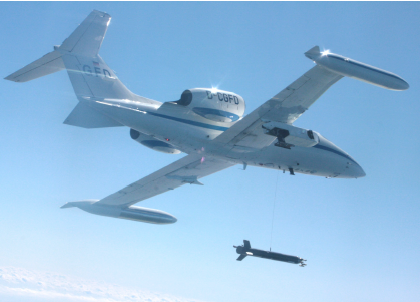
The Learjet aircraft with the towed sensor shuttle (TOSS) during a mission 2013 (photo: M. Klingebiel)
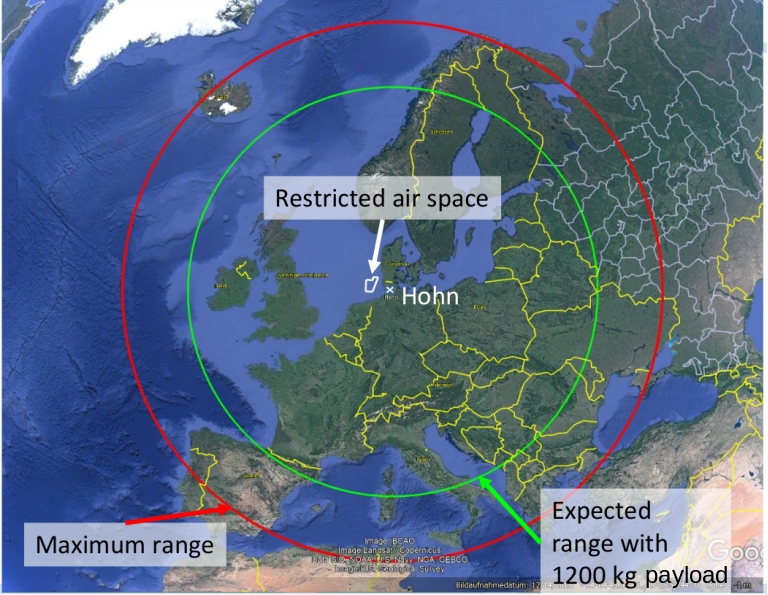
Flights with the TOSS are limited to the restricted air space at the North Sea (white), while flights without the TOSS range over central Europe (red/green circle).
The following instruments are deployed on the Learjet aircraft, on the towed sensor shuttle (TPC-TOSS, see Bozem et al., 2025) and in the wingpod of the aircraft (Knuffi):
Trace gas species
| Project | Instrument | Species | Learjet | TOSS | Knuffi |
| C01 | FISH | H2O (water vapor) | x | ||
| C01 | WASUL | Total water, water vapor | x | ||
| B01 | UMAQS | CO, N2O | x | ||
| B01 | 2BTech ozone monitor | O3 | x | x | |
| C01 | IAGOS humidity sensor | RH, T | x | x | |
| B01 | Acceleration, pressure, position | Exact determination of coordinates for Learjet and TOSS | x | x |
Aerosol and cloud particles
| Project | Instrument | Species | Learjet | TOSS | Knuffi |
| A04 | UHSAS | Aerosol size distribution (60 nm – 2 μm) | x | x | |
| A03 | CPC | Aerosol number concentration (2 nm and 10 nm – 3 μm) | x | ||
| A06 | FRIDGE | Ice nucleating particles | x | ||
| A04 | CARIBIC AMS with Sky OPC | Mass concentrations of aerosol components sulfate, nitrate, ammonium and organics, aerosol size distribution in 31 channels from 250nm to 32 μm |
x | ||
| C01 | Backscatter cloud probe | Particle diameter and number concentration, LWC | x | x | |
| C01 | NIXE-CAPS | size and number density of cloud particles (0.6 – 900 μm) | x | ||
| Aerosol filter samples (impactor,thermoporetic) | Offline single particle analysis | x | |||
| A05 | SOAP | organic aerosol sampling for offline chemical analysis | x |
Other projects involved in TPEx campaign
| Project | Involvement |
| A02 | Provision of satellite data for flight planning and data interpretation |
| B02 | BISTUM: Vertical transport and processing of aerosols, trace gases (measured on MoLa, drone, balloon out of Spielberg/Vogelsberg, 50 km north-west of Frankfurt/Main) |
| B04 | Analysis of structure formation and stratosphere-troposphere-exchange, case study of tracer distribution from campaign |
| B07 | Small scale distribution of ice clouds in tropopause for theory of nucleation processes |
| B08 | Flight planning, provide tool to identify target regions |
| C01 | Provide CLaMS ice forecast, include campaign data in JULIA database |
| C07 | Effects of parameterised versus resolved convective transport and associated scavenging of UTLS relevant tracers |
Results of the TPEx campaign
Results from our central mission TPEx show, that deep convection may affect cirrus occurrence deep in the lowermost stratosphere (LMS) even in the European sub-Arctic in June thereby contributing to the water vapour variability of the LMS (C03, Konjari et al., 2025b). The TPEx mission also highlighted the importance of the local aerosol and composition structure as well as the role of cirrus particles initializing the formation of the Extratropical Transition Layer (ExTL) (B01, Emig et al., 2025; A04, Joppe et al., 2025). We found several cases of cirrus particles in subsaturated and saturated air, both in the stratosphere, potentially modifying the PV and contributing to the LMS moisture budget. The dynamical processes associated with convective or frontal uplift (including warm conveyor belts, WCBs) have a strong impact on UTLS humidity (B08, Schwenk et al., 2025) and aerosol properties (A04, Joppe et al., 2025). Linked to this, a surprising large variety of organic aerosol species has been measured in the LMS (A05, Breuninger et al., 2025) with yet unknown impact on UTLS ice particle and aerosol distribution. A possible pathway for transport of organic compounds into the UTLS is riming during convective transport in mixed-phase clouds. Compounds dissolved in the supercooled cloud droplets can remain in the ice or be released to the gas phase during freezing. The retention coefficient describes the amount that remains in the ice phase. Measurements of retention coefficients have been conducted at the Mainz vertical wind tunnel (A05, Borchers et al., 2024). To obtain a better understanding of organic compounds available for possible inflow into convective cells, a drone-based sampling system for off-line analysis of organic aerosol particle was developed (A05, Borchers et al., 2025).
Contributing Campaigns
Chemistry of the Atmosphere: Field Experiment in Brazil
From the campaign website: The main objective of CAFE-Brazil is to study tropospheric oxidant photochemistry in combination with particle formation and growth mechanisms under clean, pristine conditions over the Amazon rainforest, and contrast the results with those in marine and polluted conditions, in part from previous measurement campaigns.
HALO deployment base: Manaus, Brazil, Time period: from September 2022 to February 2023
Mission overview paper: Curtius, J., Heinritzi, M., Beck, L.J. et al. Isoprene nitrates drive new particle formation in Amazon’s upper troposphere. Nature 636, 124–130 (2024). https://doi.org/10.1038/s41586-024-08192-4

PHILEAS (2023)
Probing High Latitude Export of air from the Asian Summer Monsoon
From the campaign website: To investigate the relative importance of processes contributing to the chemical composition of the UTLS, the HALO mission PHILEAS aims to characterize the evolution of the chemical composition of filaments during the full life cycle of eddy shedding process from the monsoon anticyclone and their effect particularly on the gradients of radiatively active species in the UTLS.
HALO deployment base: Anchorage, Alaska and Oberpfaffenhofen, Germany, Time period: from June to October 2023
Please find at the site of MPIC ⇒ more information
A very interesting video introducing the campaign can be found here ⇒ Video on PHILEAS on YouTube channel of Research Center Juelich
Mission overview paper: Riese, M., Hoor, P., and Coauthors, 2025: Long-range transport of polluted Asian summer monsoon air to high latitudes during the PHILEAS campaign in the boreal summer 2023. Bull. Amer. Meteor. Soc., , BAMS-D-24-0232.1, https://doi.org/10.1175/BAMS-D-24-0232.1, in press.
ASCCI (2024-2025)
Arctic Springtime Chemistry Climate Investigations
From the campaign website: ASCCI will focus on the high Arctic during spring.The capabilities of HALO will enable science flights into the high Arctic up to the North Pole and possibly even beyond. Research topics:
-
- Inter-annual variability of Arctic lower stratospheric ozone depletion and the implications for radiative forcing and surface climate impacts of ozone recovery
- High latitude stratosphere-troposphere exchange and the structure of the high latitude tropopause
- Short-lived climate pollutants (ozone, aerosols) and their precursors in the Arctic mid and upper troposphere
HALO deployment base: Kiruna, Sweden and Oberpfaffenhofen, Germany, Time period: December 2024 to April 2025

AEROCLOUD (2027)
AEROsol and CLOUD effects related to aviation
From the campaign website: AEROCLOUD will provide a comprehensive data set on the distribution of natural and anthropogenic aerosols in American and European mid-latitudes to advance our understanding on effects of aircraft and wildfire emissions on clouds, dynamics and climate.
HALO deployment base: Oberpfaffenhofen, Germany, Time period: June to October 2027
CONTANGO-FIRE (2027-2028)
CONvection, upper Troposphere Aerosol Nucleation, Gas phase Oxidation, and influence of wildFIREs on atmospheric chemistry and climate experiment
From the campaign website: The CONTANGO-FIRE mission will focus on three research topics:
-
- Influence of Deep Convection over South America on the UTLS composition
- Upper tropospheric new particle formation and gas phase oxidation
- Influence of Wildfire emissions on atmospheric chemistry, clouds and climate
HALO deployment base: Mendoza, Brazil, Time period: November 2027 to February 2028