

Project B01:
Exchange of humidity and aerosol particles at the tropopause: Dynamics versus moist diabatics and radiation
Brief Summary
In this project we want to study the processes which lead to the formation and composition of the extratropical transition layer (ExTL) at the extratropical tropopause. We will focus especially on the vertical gradients of water vapour, ice and aerosol particles and the related exchange processes under typical mid latitude non-convective synoptical conditions in spring and early summer. During Phase I of TPChange we found strong signatures of convection contributing to the ExTL composition in combination with vertical and horizontal shear. Here we want to study the impact of synoptic scale waves and typical mid-latitudinal baroclinic wave activity on the formation processes of the ExTL, which is a feature of the UTLS all year around. We will use a novel measurement approach, the TropoPause Composition TOwed Sensor Shuttle (TPC-TOSS) for temperature, ozone, humidity and aerosol size distribution gradients at the tropopause, which was successfully applied during Phase I of TPChange. We will combine the results with Lagrangian ensemble backward and forward trajectories driven by
ICON forecast data as well as high resolution simulation data from the MECO(n) model system. These complementing models allow an analysis of the chemical aerosol and gas phase evolution as well as the thermodynamical developments. MECO(n) permits simulations with a resolution of down to 1 km in the horizontal and approximately 200 m in the vertical. With these methods we will focus on three aspects of fine scale processes contributing to cross tropopause exchange and the vertical gradients of water and cirrus particles as well as aerosol at the tropopause:
-
- What is the role of shear driven processes on the formation of the ExTL?
- Which role do moisture related processes play for the formation of the ExTL?
- What is the impact of such processes on the aerosol content and the size distribution and its development in the ExTL?
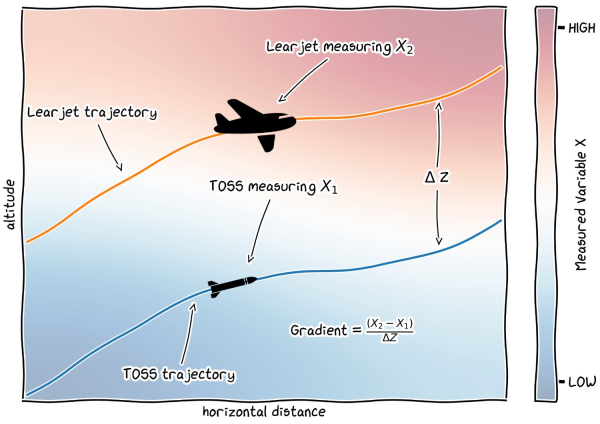
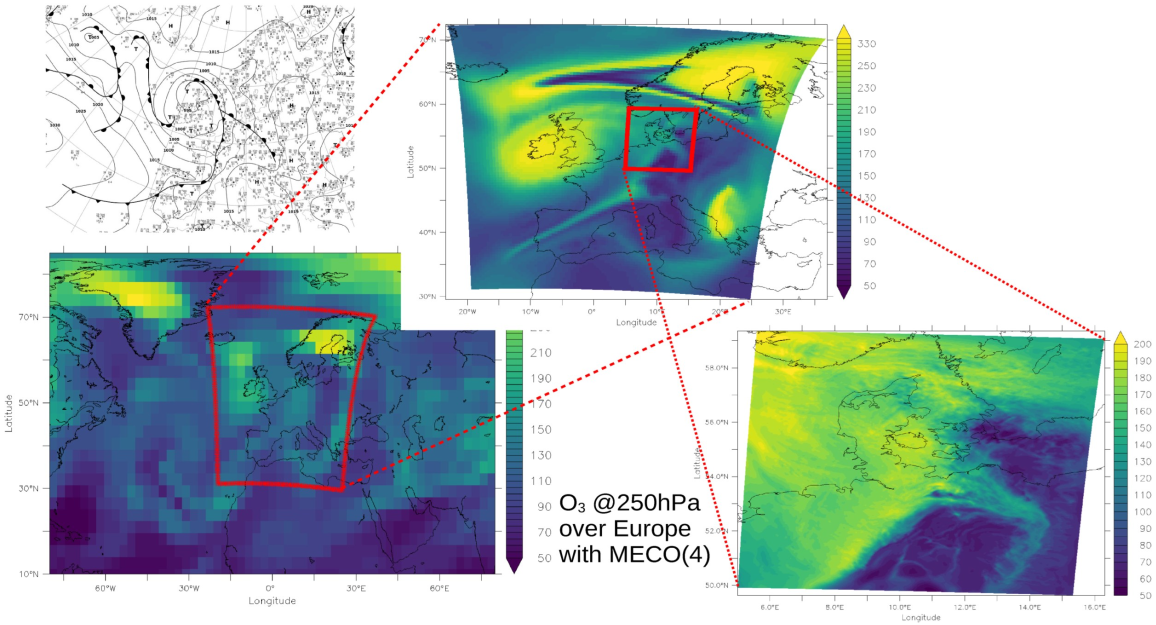
Schematic setup of the measurement setup and example of the model capabilities for high resolution simulations.
Project Poster
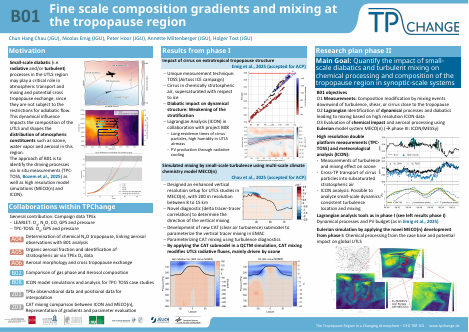
Evaluation Poster Phase I in 2025
Members

Prof. Dr. Peter Hoor
Principal Investigator
Johannes Gutenberg-Universität Mainz, Institut für Physik der Atmosphäre
hoor[at]uni-mainz.de

Jun.-Prof. Dr. Anette Miltenberger
Principal Investigator
Johannes Gutenberg-Universität Mainz, Institut für Physik der Atmosphäre
amiltenb[at]uni-mainz.de

Prof. Dr. Holger Tost
Principal Investigator
Johannes Gutenberg-Universität Mainz, Institut für Physik der Atmosphäre
tosth[at]uni-mainz.de

Nicolas Emig
Doctoral Candidate
Johannes Gutenberg-Universität Mainz, Institut für Physik der Atmosphäre
niemig[at]uni-mainz.de

Yaqi Yang
Doctoral Candidate
Johannes Gutenberg-Universität Mainz, Institut für Physik der Atmosphäre
yayang[at]uni-mainz.de

Former Member Phase I:
Chun Hang Chau
Doctoral Candidate
Johannes Gutenberg-Universität Mainz, Institut für Physik der Atmosphäre
Publications
Chau, C. H., P. Hoor, K. Kaiser, and H. Tost (2026): Parametrizing the mixing by clear air turbulence in the chemistry climate model EMAC and its respective radiative impact. Atmospheric Chemistry and Physics 26 (5), 3637–3652. doi: 10.5194/acp-26-3637-2026
Emig, N., A. Miltenberger, H. Bozem, M. Krämer, A. Afchine, D. Kunkel, H.-C. Lachnitt, Y. Li, P. Reutter, C. Rolf, N. Spelten, H. Tost, and P. Hoor (2026): Turbulent mixing at the polar jet and transport of cirrus particles into the lowermost extratropical stratosphere. EGUsphere 2026, [Preprint], 1–24. doi: 10.5194/egusphere-2026-4614
Bauchinger, S., A. Engel, M. Jesswein, T. Keber, H. Bönisch, F. Obersteiner, A. Zahn, N. Emig, P. Hoor, H.-C. Lachnitt, F. Weyland, L. Ort, and T. J. Schuck (2025): The extratropical tropopause – trace gas perspective on tropopause definition choice. Atmospheric Chemistry and Physics 25 (21), 14167–14186. doi: 10.5194/acp-25-14167-2025
Bozem, H., P. Joppe, Y. Li, N. Emig, A. Afchine, A. Breuninger, J. Curtius, S. Hofmann, S. Ismayil, K. Kandler, D. Kunkel, A. Kutschka, H.-C. Lachnitt, A. Petzold, S. Richter, T. Röschenthaler, C. Rolf, L. Schneider, J. Schneider, A. Vogel, and P. Hoor (2025): The TropoPause Composition TOwed Sensor Shuttle (TPC-TOSS): a new airborne dual platform approach for atmospheric composition measurements at the tropopause. Atmospheric Measurement Techniques 18 (22), 6545–6568. doi: 10.5194/amt-18-6545-2025.
Breuninger, A., P. Joppe, J. Wilsch, C. Schwenk, H. Bozem, N. Emig, L. Merkel, R. Rossberg, T. Keber, A. Kutschka, P. Waleska, S. Hofmann, S. Richter, F. Ungeheuer, K. Dörholt, T. Hoffmann, A. Miltenberger, J. Schneider, P. Hoor, and A. L. Vogel (2025): Organic aerosols mixing across the tropopause and its implication for anthropogenic pollution of the UTLS. Atmospheric Chemistry and Physics 25 (22), 16533–16551. doi: 10.5194/acp-25-16533-2025.
Chau, C. H., P. Hoor, and H. Tost (2025): Simulated mixing in the UTLS by small-scale turbulence using multi-scale chemistry-climate model MECO(n). Atmospheric Chemistry and Physics 25 (20), 13123–13140. doi: 10.5194/acp-25-13123-2025
Emig, N., A. K. Miltenberger, P. M. Hoor, and A. Petzold (2025): Impact of cirrus on extratropical tropopause structure. Atmospheric Chemistry and Physics 25 (20), 13077–13101. doi: 10.5194/acp-25-13077-2025.
Jesswein, M., V. Lauther, N. Emig, P. Hoor, T. Keber, H.-C. Lachnitt, L. Ort, T. Schuck, J. Strobel, R. Van Luijt, C. M. Volk, F. Weyland, and A. Engel (2025): Tracing elevated abundance of CH2Cl2 in the subarctic upper troposphere to the Asian Summer Monsoon. Atmospheric Chemistry and Physics 25 (14), 8107–8126. doi: 10.5194/acp-25-8107-2025
Karbach, N., L. Höhler, P. Hoor, H. Bozem, N. Bobrowski, and T. Hoffmann (2024): Preparation of low-concentration H2 test gas mixtures in ambient air for calibration of H2 sensors. Atmospheric Measurement Techniques 17 (13), 4081–4086. doi: 10.5194/amt-17-4081-2024.
Lachnitt, H.-C., P. Hoor, D. Kunkel, M. Bramberger, A. Dörnbrack, S. Müller, P. Reutter, A. Giez, T. Kaluza, and M. Rapp (2023): Gravity-wave-induced cross-isentropic mixing: a DEEPWAVE case study. Atmospheric Chemistry and Physics 23 (1), 355–373. doi: https://doi.org/10.5194/acp-23-355-2023.