
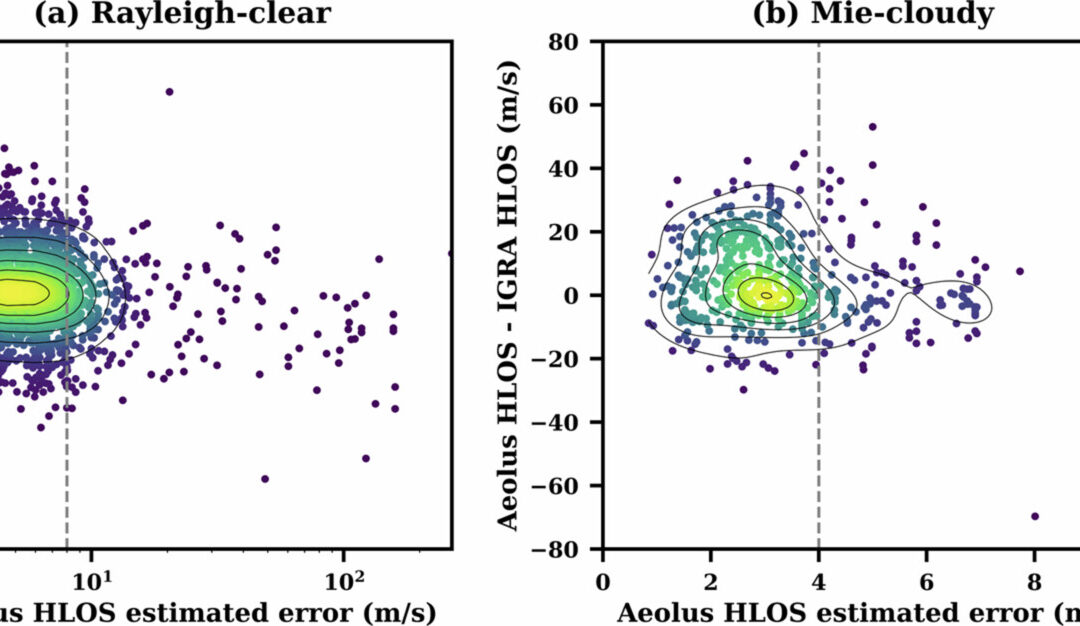
1) Comprehensive evaluation of Aeolus wind measurements against in situ observations and reanalysis datasets over the Indian monsoon region
Balasundhar, B., H. K. Alladi, M. V. Ratnam, and A. Kottayil (2026a)
European Journal of Remote Sensing 59 (1), 2712601. doi: 10.1080/22797254.2026.2712601.
Abstract: Ground-based and balloon-borne instruments are available for wind measurements but are limited in spatial coverage. At this juncture, the Aeolus satellite with the first spaceborne Doppler wind lidar marked a breakthrough in global wind profiling by providing Horizontal Line of Sight (HLOS) wind observations in the Rayleigh and Mie channels across the troposphere and lower stratosphere. In this study, we conducted an comprehensive validation of the ascending and descending Aeolus Level-2B (L2B) wind products in these channels using GPS radiosonde observations launched at 00 UTC and 12 UTC over India Meteorological Department (IMD) locations from June 2019 to October 2022. Aeolus HLOS winds were also compared with global (ERA5) and regional (IMDAA) reanalysis datasets. The retrieval assessment was further refined by categorizing the wind data into different seasons: pre-monsoon, monsoon, post-monsoon and winter. A good correlation between the Aeolus and in situ wind measurements, with a correlation (bias) of 0.64 (1.21 m/s) for Rayleigh-clear and 0.62 (5.08 m/s) for the Mie-cloudy retrievals is observed. Biases, with differences in magnitude, were observed against reanalysis datasets. This study quantifies wind measurement biases over the Indian monsoon region, providing a basis for assessing the suitability of Aeolus HLOS winds for potential assimilation into WRF models.
2) Evaluating Aeolus HLOS Winds and Characterizing the Low-Level Jet (LLJ) and Tropical Easterly Jet (TEJ) over the Indian Summer Monsoon: An Intercomparison with Radiosonde and Reanalysis Datasets.
Balasundhar, B., H. K. Alladi, M. Venkat Ratnam, M. Ratynski, and P. Singh (2026b)
Remote Sensing 18 (18), doi: 10.3390/rs18183077.
What are the main findings?
-
Aeolus Rayleigh-clear HLOS wind retrievals show excellent agreement with radiosonde observations (correlation coefficient = 0.95, bias = 0.11 m/s), with accuracy improving to R = 0.97 in the upper troposphere and lower stratosphere (UTLS), while Mie-cloudy retrievals perform markedly weaker.
-
The vertical structure and intensity of the Low-Level Jet and Tropical Easterly Jet derived from Aeolus agree more closely with radiosonde observations than with ERA5, MERRA-2, and NCEP-2 reanalyses, with NCEP-2 showing the largest deviations.
-
Aeolus demonstrates strong potential as a reliable, independent wind observation source for validating and improving reanalysis products over the data-sparse Indian Ocean region.
-
These findings support the use of Aeolus Doppler wind lidar observations to enhance monitoring and prediction of Indian Summer Monsoon circulation dynamics.
Related TPChange projects:
B03 Moist convection and tracer transport into and out of the Asian Summer Monsoon Anticyclone