
Impact of small-scale gravity waves on tracer transport
Knop, I., S. Dolaptchiev, and U. Achatz (2026):
Quarterly Journal of the Royal Meteorological Society 152 (776), e70091. doi: https://doi.org/10.1002/qj.70091.
Abstract
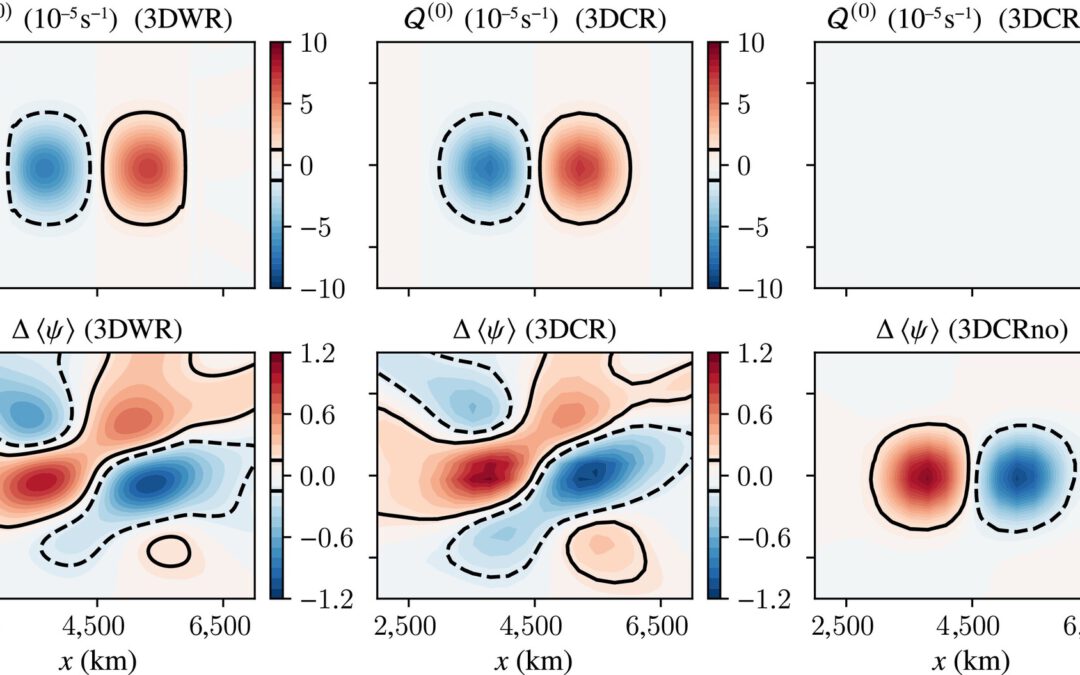
Small-scale gravity waves, with horizontal wavelengths of up to a few hundred kilometers and vertical wavelengths of up to a few kilometers, play a crucial role in atmospheric tracer transport. However, their effects remain unresolved in climate models and must be parametrized. This study investigates how gravity waves influence large-scale tracer distributions, utilizing a multiple-scale analysis to systematically identify the governing terms of gravity wave-induced tracer fluxes. The analysis reveals both leading-order and next-order impacts: the former being the inertia–gravity-wave-induced tracer Stokes drift, which acts perpendicular to both the large-scale tracer gradient and the wave number, whereas the latter becomes significant at lower latitudes where Coriolis effects diminish. A numerical framework is developed to incorporate these fluxes into a gravity wave parametrization model, potentially enhancing climate model accuracy without requiring explicit resolution of small-scale wave dynamics. Model validation against high-resolution wave-resolving simulations confirms the effectiveness of this approach. By improving the representation of gravity-wave-induced tracer transport, this research advances the accuracy of climate simulations, particularly in their depiction of microphysics and radiative processes.
Related TPChange projects: